Skip to main content
Food for Life Celebrates 25 Years of Helping People Get Healthy With a Plant-Based Diet
“This class was so much fun and, at the same time, educational.”
That was the praise of a participant who took a plant-based nutrition and cooking class series on cancer prevention and survival in 2001 taught by Physicians Committee President Neal Barnard, MD, and other nutrition experts in the Physicians Committee’s Washington, D.C., office.
“That pioneering class didn’t just share the scientific evidence for why a plant-based diet is beneficial,” says Dr. Barnard. “It showed participants how to put the science into practice with cooking demonstrations of delicious and nutritious cancer-fighting meals.”
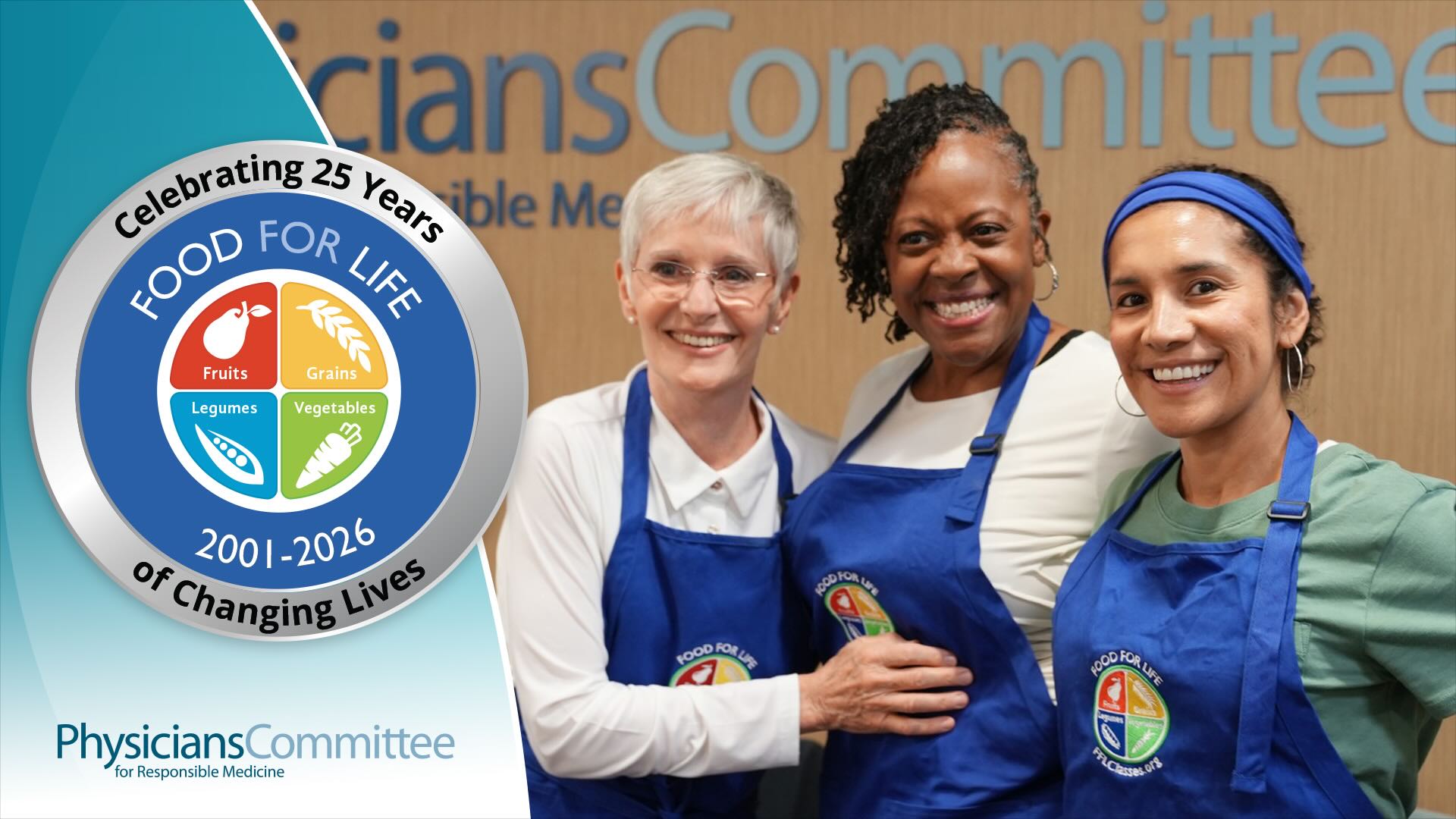
That single class series was the blueprint for what evolved and expanded into the Physicians Committee’s Food for Life plant-based nutrition and cooking class program, which—25 years later—has more than 450 instructors and institutions across the globe teaching thousands of classes a year to tens of thousands of participants.
From Beating Breast Cancer to Boosting Brain Health
Designed by physicians, nurses, and dietitians, Food for Life classes promote healthful plant-based eating based on the latest scientific research. Each class includes information about how certain foods and nutrients work to promote or discourage disease, cooking demonstrations of delicious and healthful plant-based recipes, and practical cooking skills and tips for incorporating healthful eating habits into daily life.
Today, Food for Life class series or individual classes include African American Culinary
Heritage, Cancer Project, Cooking to Combat COVID-19, Kickstart Your Health, Diabetes
Initiative, Nutrition Essentials, Healthy Basics, Kids Health, Employee Wellness Program, Your Body in Balance, Let’s Beat Breast Cancer, Foods for a Healthy Heart, Power Foods for the Brain, Food and Fitness, and Universal Meals.
To reach a wider audience, several of the class curricula have also been translated into French, Mandarin, and Spanish.
In 2025, the Food for Life program added two new classes—Eating With Purpose and Navigating Travel—and continues to develop new curricula based on class participant feedback.
While the Food for Life program now has hundreds of instructors, with dozens of new ones being trained each year, many have been with the program for years.
Teaching Food for Life Since 2005
Tracy Childs, a Food for Life instructor in San Diego, Calif., first read about the program in Good Medicine in the early 2000s and was intrigued.
“I had researched foods and diets for cancer prevention with family members in mind and was also considering doing nutrition and cooking classes, but I didn’t know where
to start,” recalls Childs. “When I heard that the Physicians Committee was piloting a program, I followed along. In 2005, when the program expanded beyond D.C., I was very excited to be a member of the second group of licensed instructors!”
She says that one of the first places she taught the Cancer Project curriculum was at hospitals, where they promoted the classes to cancer patients, a few of whom she
has stayed in touch with.
“I became ‘besties’ with Charlie, who has followed a vegan diet since her breast cancer diagnosis, and I’m thrilled that she is now celebrating over 10 years being cancer-free!” she says.
Childs, who also runs PlantDiego, a support organization for anyone in San Diego interested in plant-strong eating, says she always recommends becoming an instructor, adding, “It’s a lot of work, but the work is so rewarding. If you believe in the power of a plant-based diet and wish to make an impact in your community, go for it!”
From Class Participant to Instructor
Diane Callaway, another longtime Food for Life instructor, first began her journey toward a plant-based diet after she lost her mother, who was in her early 50s, to breast cancer.
Shortly after, her father passed away from heart disease. To learn more about the connection between diet and disease, she and her husband began taking a Food for Life class.
“We came from Delaware to D.C. every day and sat in the classes and were blown away by what we learned about the health benefits of a plant-based diet,” says Callaway. “I knew
we needed to make a change after those classes.”
In 2010, she became a Food for Life instructor and began teaching classes in her community around Bear, Del.
“I am committed to getting people to understand that this is doable. It worked for me. It worked for my family. It worked for my cousins. They're still alive. They have grand-
children now,” she says, adding that she asks her class participants to share some of what they’ve learned about a plant-based diet with at least 10 people within 60 days of finishing
the class to help spread the message.
Helping Instructors Reach Underserved Communities
Since launching in late 2024, Food for Life’s grant program, which provides financial support to instructors who offer free classes that prioritize audiences disproportionately
impacted by chronic disease, has supported classes reaching thousands of people in countries including Brazil, Canada, Chile, France, Mexico, Thailand, Uganda, and the United States. Several instructors recently taught grant-supported classes, helping underserved communities learn more about the power of a plant-based diet for disease prevention.
Maria Fernanda Hubeaut, of Kingston, N.Y., hosted an online Diabetes Initiative class in Spanish, reaching primarily Latina women from New York state and several from Ecua-
dor. Her class audience included immigrant workers facing significant barriers to better health.
In Norfolk, Va., Sahrah Yashaahla hosted a Tackling Menopause class for an audience of primarily African American women over the age of 40 who are disproportionately impacted by chronic diseases such as diabetes and heart disease.
Participants reported that the culturally relevant class content and group discussion allowed them to feel seen, heard, and empowered and that they were motivated to eat more plant-based meals.
Leah Ogeto, of Des Moines, Iowa, taught a Diabetes Initiative class series at the Des Moines Seventh-day Adventist Church in partnership with the church-sponsored food
pantry. About 80% of the food pantry clients have been diagnosed with diabetes, and half of them are retired and living within limited means. After four weeks, one participant reported that at his regular checkup, his A1C level had dropped sufficiently low for his doctor to advise him to eliminate most of his diabetes medication.
This spring, the grant program will support several instructors who are teaching Healthy Food Makes Cents, a new campaign aimed at opening a pathway to better health at a time
when insurance, health care, and food costs are all rising and social support is declining. The classes are from the Healthy Basics series, which is specifically designed to serve low-income communities disproportionately impacted by chronic disease.
In addition to grants for existing instructors, the Food for Life program also awards scholarships to Food for Life instructor training applicants who commit to reaching under-
served and marginalized audiences.
The Future Faces of Food for Life
This April through June, the Food for Life program will train its latest group of instructors, who will begin teaching classes later this year. Last year’s graduating class included 44 new instructors and five institutions, including three medical doctors, three nurses and nurse practitioners, two registered dietitians, two physician assistants, and three professional chefs.
“I’m grateful for the opportunity to be part of this program,” said one of the 2025 graduates. “It has equipped me with science-based knowledge that bridges the gap between medical advice and at-home practice. This program enables collaboration between health care professionals and instructors like me to empower people in managing their health through nutrition. I’m excited about the impact this partnership can have on improving lives.”
To find a class and learn more about the Food for Life program, visit PCRM.org/FFL.