Skip to main content
Congress Advances Provisions Expanding Nondairy Milk Access in Schools

WASHINGTON, D.C. — The Physicians Committee for Responsible Medicine, Friends of the Earth U.S., and other members of the Plant Powered School Meals Coalition applaud the U.S. House of Representatives for advancing provisions that will make it easier for students to access nondairy milk options in schools. The changes, included in the amended Whole Milk for Healthy Kids Act (S.222), were passed by the full U.S. Senate in November and by the House today. They remove key barriers in federal law that have long prevented students, especially those who are lactose intolerant, from receiving a nutritionally appropriate beverage option at school.
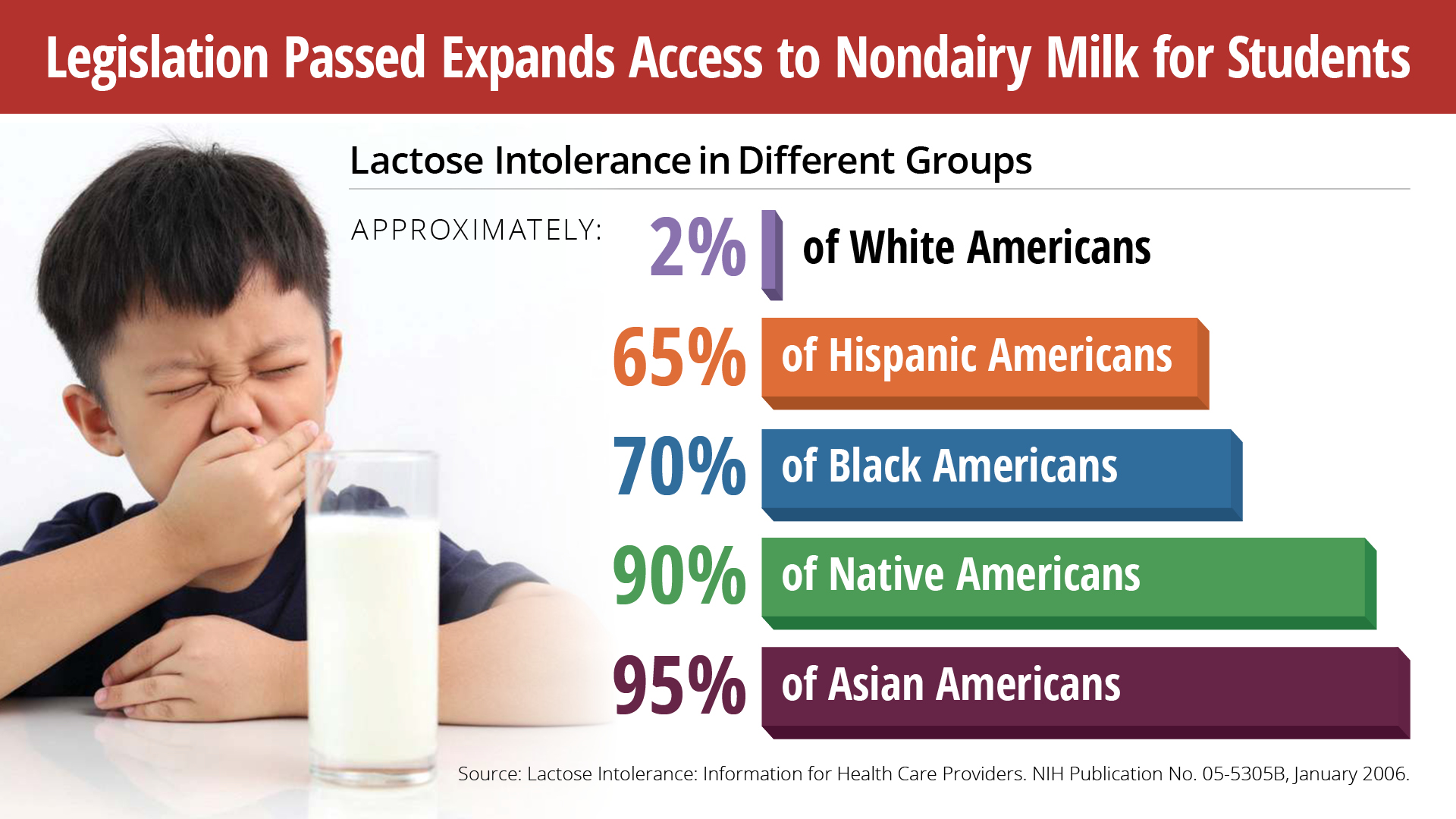
Under current law, students are only guaranteed a substitute for cow’s milk — such as fortified soy milk — if a parent submits a physician’s note documenting a disability, and schools are prohibited from proactively offering soy milk in the lunch line. This red tape places an unnecessary burden on families and disproportionately impacts communities of color: Approximately 95% of Asians, 60% to 80% of African Americans, 80% to 100% of American Indians, and 50% to 80% of Hispanics are lactose intolerant, according to the National Institutes of Health.
“This legislation makes it so much easier for parents like me to ensure that their child with lactose intolerance gets a healthy plant-based milk in school,” says Stephanie McBurnett, RDN, a nutrition educator for the Physicians Committee for Responsible Medicine. “It’s a win for the millions of children who experience pain and discomfort from cow’s milk and for those who simply want a nondairy alternative.”
“All students should be able to access the nutrition they need to thrive and receive beverages they can actually drink,” said Chloë Waterman, Senior Program Manager at Friends of the Earth. “Removing barriers for students to access nondairy milk options will help school meals align more with dietary science, expand healthy choices for families, and reduce food waste. We appreciate Congress’ leadership in ensuring equitable access to nutritionally appropriate beverages at school and urge schools to take advantage of their new ability to offer soy milk on the lunch line without requiring a note.”
If signed into law, these changes would allow schools to offer a nutritionally equivalent nondairy milk option to all students and would require schools to provide a cow’s milk substitute for any student who has a disability — which USDA considers to include lactose intolerance — based on a parental request.
Soy milk is a safe and nutritious option for children with lactose intolerance, dairy allergies, or other dietary requirements or preferences. The 2020-2025 Dietary Guidelines for Americans, the Centers for Disease Control and Prevention, and major health organizations recognize fortified soy milk as a nutritionally equivalent alternative to dairy milk.
“I’m lactose intolerant, so I can't drink the milk that comes with my school lunch because I don’t want to get sick,” said Yandel Ramirez, a high school student in New York City. “I have never understood why my parents and I had to go the extra mile to get a doctor's note just to receive a milk alternative I can actually drink. If schools take advantage of this new ability to offer non-dairy beverages to any student on the lunch line, we would no longer feel excluded at the lunch table."
A recent Physicians Committee for Responsible Medicine/Morning Consult poll found that two thirds of U.S. adults think that students should have access to nondairy beverages, such as soy milk, in schools.
The Whole Milk for Healthy Kids Act will also allow schools to serve full-fat whole dairy milk to students, against the overwhelming evidence that consumption of saturated fat is linked to cardiovascular disease and other diet-related conditions. However, by expanding access to nondairy milk, the legislation provides students a healthier alternative.
This progress follows years of advocacy from the Plant Powered School Meals Coalition, which works to expand nutritious and delicious plant-based food and beverage options in K-12 schools, and leadership from members of Congress on related bills, including Rep. Nydia Velázquez, D-New York, and Rep. Alma Adams’, D-North Carolina, Plant Powered School Meals Pilot Act (formerly known as the Healthy Future Students and Earth Act), and Rep. Troy Carter, D-Louisiana, and Sen. John Fetterman’s, D-Pennsylvania, FISCAL ACT. Both the Plant Powered School Meals Pilot Act, which would provide funding to schools to expand plant-based food and beverage options, and the FISCAL Act, which would require schools to offer soy milk, await further Congressional consideration.
Physicians Committee Media Contact
Michael Keevican
202-527-7367
mkeevican[at]pcrm.org
Founded in 1985, the Physicians Committee for Responsible Medicine is a nonprofit organization that promotes preventive medicine, conducts clinical research, and encourages higher standards for ethics and effectiveness in education and research.