Skip to main content
Tali Alborz Conine (November 9, 1933 – November 28, 2025)
Professor Emeritus and former Director of the School of Rehabilitation Sciences, Faculty of Medicine, University of British Columbia (UBC)
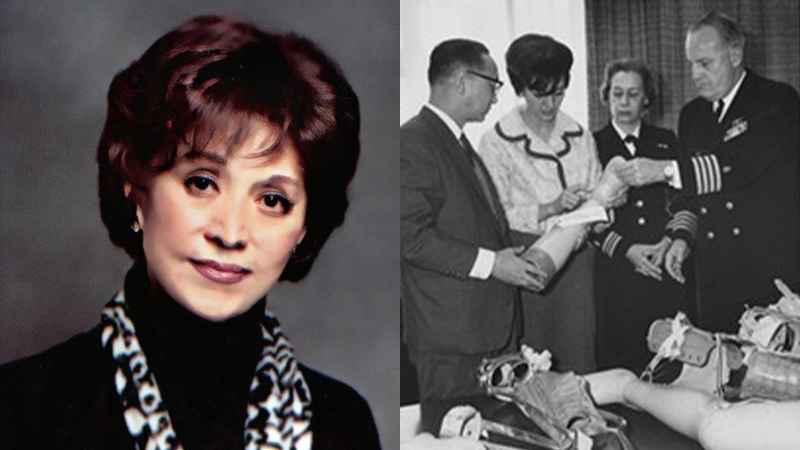
Dr. Conine - Tali, as she would have family, colleagues and friends call her - followed the footsteps of her parents, Fakhr-ul-zaman Mangeneh-Nouraie and Hossein-Ali Alborz, and dedicated her life to follow the teachings of Sa’adi (1210-1291):
"Human beings are members of a whole
In creation of one essence and soul
If one member is afflicted with pain
Other members uneasy will remain
If you have no sympathy for human pain
The name of human you cannot retain"
Sa’adi - Golestan , گلستان سعدی
Born in Tehran (Iran), Tali graduated from the Seventh-day Adventists (Mission of the Middle East Union, Tehran) in 1951; and received her Bachelor of Sciences in Physical Therapy and Masters of Arts in Business Administration from New York University - respectively in 1955 and 1956. She returned to Iran in 1957 and was a member of the medical staff at Namazi Hospital in Shiraz – where she met and married Colonel Robert E. Conine in 1959.
From 1962 to 1966, Tali served as a special adviser with the World Health Organization (WHO), working closely with the Ministry of Welfare of Japan to strengthen its emerging rehabilitation systems. In 1963, she became the inaugural Dean of the Department of Physiotherapy, School of Rehabilitation (Tokyo National Hospital) - where Japan’s first formal training programs of physical and occupational therapists were constituted. With her emphasis on patient contact and interaction in clinical settings, Tali laid the foundation and formulated the school’s philosophy and vision – in her words “education rooted in clinical practice”.
Under her leadership, the school played a foundational role in shaping the modern rehabilitation education/sciences and establishing Japan’s national standards. Her work during these formative years left a lasting impression on rehabilitation practice and professional training across Japan.
Her students in Japan recall her as “beautiful, but passionate, highly responsible, strict, and someone who scolded us often.” She “blended strictness with humor and kindness” … “a physical therapist, a working woman, and someone with impeccable fashion sense, Dr. Conine was always [a] role model”.
In recognition of her contributions in teaching and establishment of modern physical therapy and rehabilitation practices, she received the Distinguished Service Medal from the Government of Japan in 1966. Her book, Essentials of Physical Therapy (1966) is considered by colleagues and peers in Japan as foundational and seminal
Upon returning to the United States, she completed her Doctorate in Public Health and Safety at Indiana University in 1968, with her dissertation titled “Teachers’ Attitudes Towards Disabled Persons”. She pursued her postdoctoral work in the Administration of Allied Health Programs in Burlington, Vermont.
From 1972 to 1979, Tali served as a Professor of Physical Therapy and Chairperson of Allied Health Sciences in the School of Medicine at Indiana University-Purdue University Indianapolis (IUPUI). In this dual role, she helped shaping the academic direction of the Allied Health programs, advancing curricula, and expanding clinical training opportunities for students in physical therapy and related disciplines. In recognition of her outstanding commitment to teaching and mentorship, she received Indiana University’s Frederic Bachman Lieber Memorial Award for Distinguished Teaching in 1976.
In 1979, she was appointed to the University of British Columbia (UBC) as Professor of Physical Therapy and Director of the School of Rehabilitation Sciences within the Faculty of Medicine. Tali’s appointment marked a significant turning point in the evolution of rehabilitation professions in Canada and internationally. As physical therapy and occupational therapy shifted toward evidencebased research, she took on the responsibility of recruiting faculty with doctoral training who were active scholars and skilled in securing research funding, while also supporting several existing faculty members in pursuing their PhDs. She both inspired and challenged colleagues with her bold vision for health care and the rehabilitation sciences. Tali laid the foundation for what would become the strong research programs of today’s Department of Physical Therapy and the Department of Occupational Science and Occupational Therapy within UBC’s Faculty of Medicine. In 1995, she stepped down as the Director of the School of Rehabilitation Sciences but remained on faculty until her retirement in 1998.
Tali was widely recognized as an innovator, pioneer, and educator in rehabilitative sciences. With over 80 publications – a figure seldom reached before the proliferation of the internet and when physical therapist seldom became scientists in the newly emerging field where the clinical practice and academia were being defined and integrated – she was a Fellow of the American Society of Allied Health Professionals and a member of the International Who’s Who in Medicine,
Tali – the mother, the family matriarch, the teacher, friend and protector - touched and nourished many lives. Phoenix–like she spread her wings vast. From her ashes we celebrate the Tree of Life - its lasting renewal:
"Round and round this heap of ashes
Now flies the bird amain
But in that odorous niche of heaven
Nestles the bird again"
Hafez Shirazi (1325–1390)حافظ شیرازی
[Translated by Ralph Waldo Emerson]
Canadian donors can make tax-deductible gifts through CAF Canada. Select: Alternatives to the use of animals in medical education and research (Physicians Committee for Responsible Medicine).