Skip to main content
New Survey on Strike at JBS Meatpacking Facility Shows Most Americans Prioritize Workers’ Rights Over Beef Production
Younger Americans Favor Transition of Slaughterhouses to Facilities to Produce Plant-Based Protein; Most Americans Believe Migrant Meatpackers Should Not Be Subjected to Immigration Enforcement
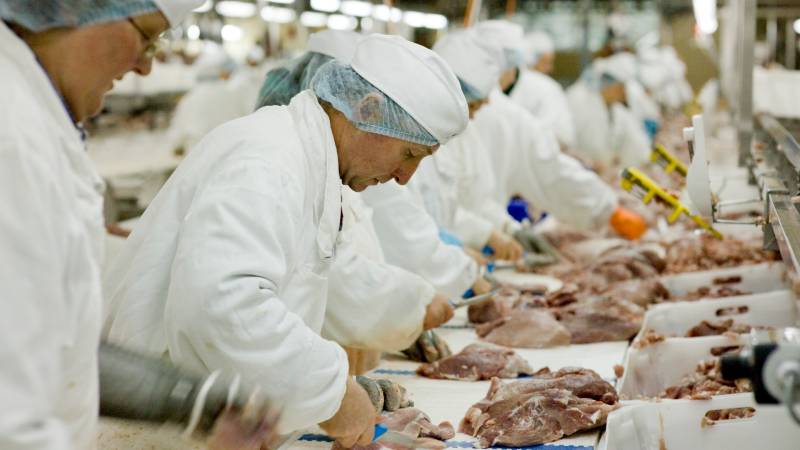
WASHINGTON—A new survey by Morning Consult and the nonprofit Physicians Committee finds that in response to the workers’ strike at one of the country’s largest slaughterhouses, a JBS facility in Colorado, a large percentage, 71%, of Americans say workers have the right to strike as opposed to staying on the job to continue beef production. In a separate survey question, younger Americans favor the transition of slaughterhouses to produce plant-based protein. The Physicians Committee is a nonprofit health advocacy organization with 17,000 physician members nationwide.
According to the new survey, most Americans, 61%, believe that migrant meatpacking workers who are currently striking for safer working conditions should not be targeted for immigration enforcement activities.
Economically, it makes sense for the large meat companies, like JBS, to focus on the plant-based products they are already producing because, according to the Wall Street Journal, meat companies are losing money producing beef. The Wall Street Journal notes, “JBS, the world’s largest meatpacker, reported a $617 million adjusted operating loss for its beef business over the past year. A year earlier, the loss was $37 million.”
Detailed Survey Results:
Survey Question: PCRM1 - Meatpacking workers at a JBS slaughterhouse in Greeley, Colorado recently went on strike, citing concerns about pay and workplace safety. Do you think meatpacking workers should have the right to strike over pay and working conditions or do you think meatpacking workers should always stay on the job to continue meat production?
Meatpacking workers should have the right to strike over pay and working conditions 71%
Meatpacking workers should always stay on the job to continue meat production 11%
Not Sure 19%
The new survey finds that Americans are divided with 36% supporting and 38% opposing the transition of some slaughterhouses into facilities to manufacture plant-based foods or cell-cultivated meat. Support for converting slaughterhouses into cleaner, safer plant-based protein producers was strongest among the youngest respondents—members of Generation Z, 49%, and Millennials, 46%.
Survey Question: PCRM2 - Some have suggested that meatpacking companies like JBS should transition some of their slaughterhouses to facilities that manufacture plant-based or cell-cultivated meat products as an alternative to traditional meat processing. Do you support or oppose this idea?
Many slaughterhouse workers are migrants, including undocumented workers. Given the visibility of migrant workers on the picket line in Greeley, Colorado, there’s a concern that immigration agents might conduct a sweep of the community. But the new survey found that 61% of Americans believe that would be unfair to the striking workers.
Survey Question: PRCM3 - When workers participate in a labor strike, do you think they should face legal consequences — such as immigration enforcement action — for their participation?
Yes 19%
No 61%
Not Sure 20%
“Meatpacking is a dangerous occupation, and the results of this survey show that Americans feel compassion for employees who are striking to obtain safer working conditions,” says Xavier Toledo, MS, RD, LDN, a registered dietitian on the staff of Physicians Committee. “This also raises broader questions about how food is produced. Workers would have a cleaner and safer work environment in facilities that produce plant-based or cell-cultivated 'meat' products. JBS and other major meat companies already offer lines of plant-based protein products, showing that slaughterhouses could be used to manufacture these products instead of processing animals.”
Journalists who would like a copy of the complete survey report please contact Jeanne McVey, jeannem [at] pcrm.org (jeannem[at]pcrm[dot]org), or 202-607-1687.
Physicians Committee Media Contact
Jeanne Stuart McVey
202-527-7316
jmcvey[at]pcrm.org
Founded in 1985, the Physicians Committee for Responsible Medicine is a nonprofit organization that promotes preventive medicine, conducts clinical research, and encourages higher standards for ethics and effectiveness in education and research.